
GEO pricing varies enormously by market and scope, which makes a single number unhelpful. The more useful question is what drives the cost because that tells you whether a quote has been scoped or invented.
Four variables account for almost all of the variation:
Category competitiveness: A fragmented category with no dominant incumbent takes considerably less work than one where two brands own every answer.
Starting position: A company with existing content, some review presence and sound technical health starts months ahead of one starting from nothing.
Scope of the off-site component: This is the largest cost driver and the most commonly under-scoped. Outreach, review programmes and community work are labour-intensive and slow.
Whether content production is included: Building six comparison pages is a defined project. Ongoing content production is an open-ended commitment, and the two should be priced differently.
A quote that does not reference these variables was not scoped. It was set by what the agency thought you would pay.
What are you actually paying for?
Five components, and the proportions tell you what kind of engagement it is:
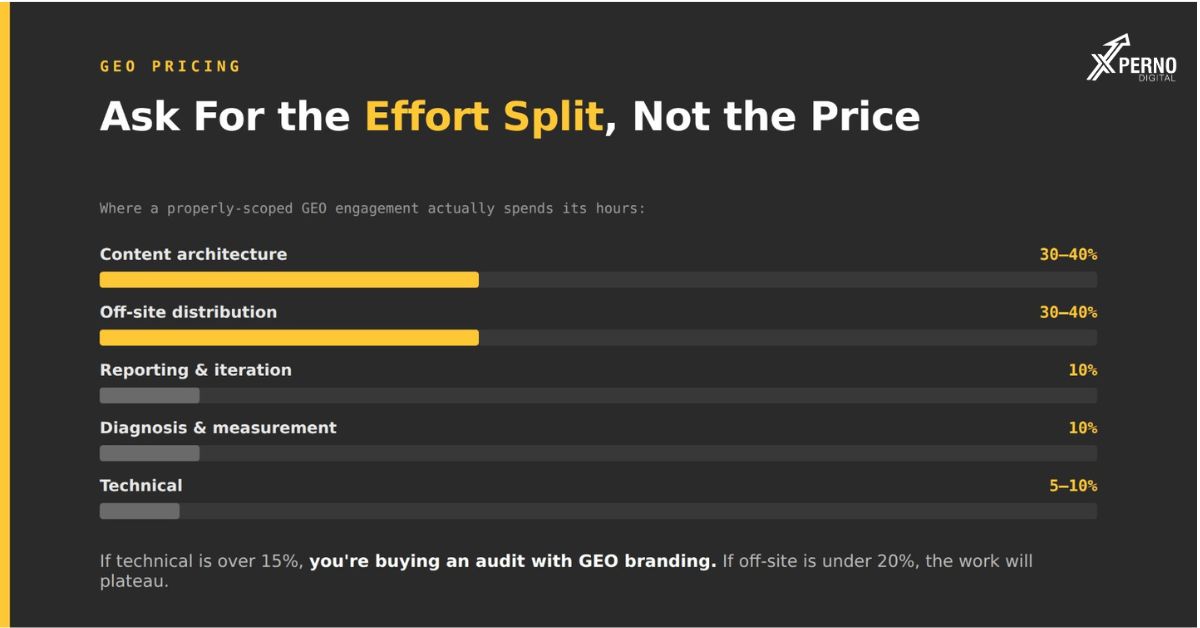
Component: Typical share of effort What it involves.
Diagnosis and measurement: 10% Prompt set, baseline, citation analysis, technical checks.
Content architecture: 30–40% Comparison, alternatives, use-case pages; extractability work.
Technical: 5–10% Schema, crawler access, rendering, structured facts.
Off-site distribution: 30–40% Roundup outreach, review programmes, listings, community.
Reporting and iteration: 10% Monthly measurement, adjustment, reporting.
What the proportions reveal?
If technical is more than 15%, you are buying a technical audit with GEO branding. Technical work removes blockers; it does not create citation.
If off-site is under 20%, the engagement will plateau. Four of the six most-cited source types are not on your domain, and no amount of on-site work substitutes.
If diagnosis is under 5%, nobody ran the check properly and the plan is generic.
Ask for the split. An agency that cannot tell you how effort divides across these has not planned the work.
Which pricing models exist?
Three structures, each suited to a different situation:
Project-based:
A defined scope with an end. Build the bottom-of-funnel set, fix technical, establish measurement.
Good for: Companies that want the foundation built and will run it themselves afterwards. Finite, evaluable, low risk.
Weak for: The off-site component, which is inherently ongoing.
Retainer:
Monthly fee for continuing work across content, distribution and measurement.
Good for: The off-site and iterative components, which need sustained effort over four to six months minimum before they land.
Where it goes wrong?: When the retainer becomes a subscription to activity rather than a route to a defined outcome. If you cannot state what you are buying beyond “GEO,” the engagement is mis specified.
The protection: Insist on stated deliverables per month, not just an hours allocation.
Hybrid:
A project fee for the foundation, then a smaller retainer for distribution and measurement.
This is usually the most honest structure, because it prices the finite work as finite and the ongoing work as ongoing. It also gives you a natural decision point after the foundation is built.
Why do quotes vary so widely?
Because “GEO” is not a defined scope, and identical-sounding proposals frequently describe very different work.
Three quotes for the same request can differ by a factor of five, and the difference is usually not margin.
What cheap quotes typically exclude?
- Off-site work entirely the slowest, most labour-intensive, most important component.
- Content production, quoted separately later.
- Genuine diagnosis, replaced by a templated audit.
- Ongoing measurement.
What expensive quotes sometimes include that you may not need:
- Comprehensive technical audits on a twelve-page site.
- Extensive schema implementation beyond the four types that matter.
- Speculative deliverables like llms.txt files presented as significant line items.
- Content volume when the constraint is content type.
How to compare fairly: Ask every agency to price the same defined scope. Six comparison and alternatives pages, technical fixes, measurement baseline, and six months of specified off-site activity. Then the numbers are comparable and the differences are meaningful.
What is the minimum viable engagement?
Diagnosis plus the bottom-of-funnel content set and if a budget cannot cover that, the honest answer is to do it yourself.
The minimum that produces results:
1. Prompt set, baseline, citation analysis (a few hours)
2. Technical checks and fixes (a day)
3. Four to six comparison and alternatives pages (20–25 hours)
4. Extractability work on key existing pages (a day)
5. Measurement baseline and monthly re-run (an hour a month)
That is roughly 40 hours of work. It is also, not coincidentally, the 90-day plan a founder can execute themselves.
Which is the honest position on small budgets? If you cannot fund a properly scoped engagement, you are better off doing the foundation yourself than buying a thin version of it. A cheap engagement that skips off-site work and produces templated content costs money and delivers nothing.
What you cannot do yourself easily? sustained outreach, review programme management, and the discipline of monthly measurement. Those are what external help is genuinely good for which is why the hybrid structure tends to fit.
What should you not pay for?
Five line items that appear on proposals and should not.
llms.txt implementation as a significant deliverable: There is no confirmed evidence major AI systems read it. It costs an hour. If it appears as a meaningful line item, that tells you something about the rest of the proposal.
Comprehensive technical audits on small sites: A twelve-page marketing site does not need a 60-point audit. Run the basic checks and move on.
“AI optimisation” with no described method: Ask what specifically is being done. If the answer is vague, there is no method.
Content volume when the constraint is content type: Twelve blog posts a month will not fix absence from comparison queries. If your existing content did not produce visibility, more of it will not either.
Guaranteed rankings or guaranteed AI citation: Nobody controls these systems. A guarantee is either meaningless or the agency is planning something you would not approve of.
How should you evaluate a quote?
Judge it on the specificity of what is being bought, not on the number.
Five questions that separate a scoped quote from an invented one:
1. How does the effort split across diagnosis, content, technical, off-site and reporting? Anyone who has planned the work can answer immediately.
2. What specifically will exist at week twelve? Deliverables, not outcomes outcomes at week twelve are largely a guess.
3. When does off-site work start, and what does it consist of? If it is not in the first two months, it will not land within six.
4. Is the generic category query realistic for us, and how did you determine that? A specific answer referencing your category is good. “Yes, with the right strategy” is not.
5. What would make you tell us not to proceed? An inability to answer suggests no judgement or no willingness to exercise it.
A note on our own position. We sell this work, so treat the above as a framework rather than as disinterested advice. The test that matters is whether an agency’s answers to those five questions are specific including ours.
Frequently Asked Questions:
Is GEO more expensive than traditional SEO?
Not inherently. The components overlap substantially. What differs is the allocation more weight on comparative content and off-site presence, less on volume publishing.
How long should I commit for?
Six months minimum for anything involving off-site work, because that component has a four-to-six-month lead time. A three-month engagement will end before the slowest work produces anything.
Should I pay per deliverable or monthly?
Project fees for finite work, retainer for ongoing distribution and measurement. The hybrid structure prices each honestly.
What if I only have a small budget?
Do the foundation yourself. Roughly 40 hours produces the diagnosis, the comparison pages and the measurement baseline. A thin engagement is worse value than your own time.
Do agencies charge more for AI visibility work?
Some price it as a premium. The underlying work is largely the same disciplines reallocated, so a substantial premium for the label is worth questioning.
How do I know if I’m overpaying?
Ask three agencies to price the same defined scope. Vague scopes produce incomparable quotes, which is how overpaying happens.