
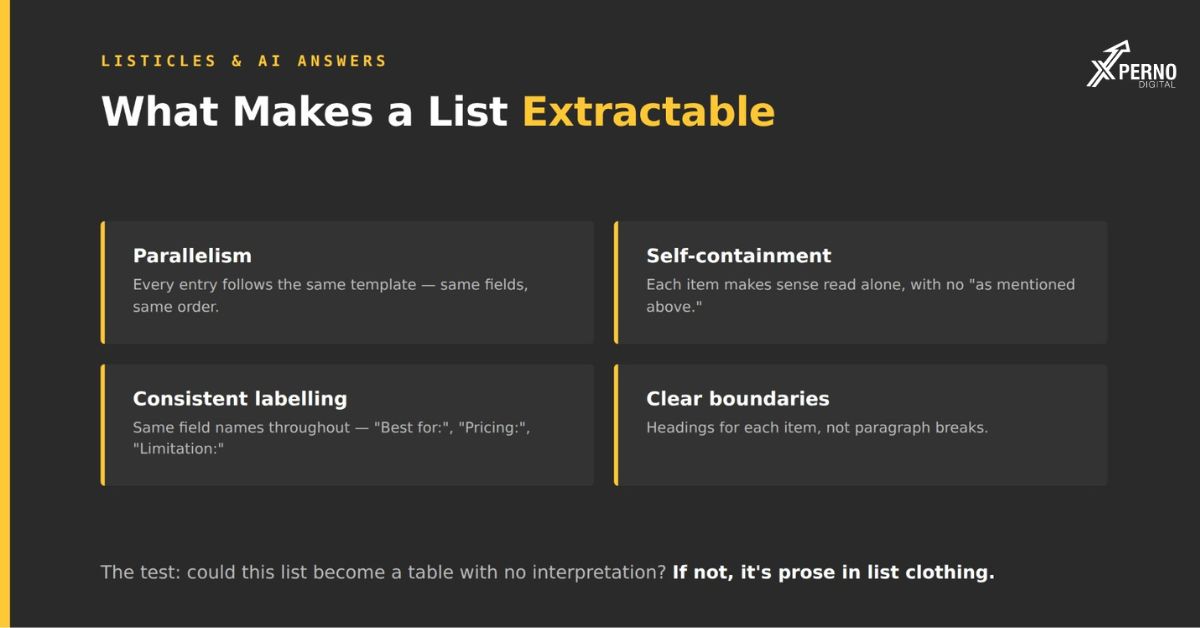
List articles get cited disproportionately because their structure matches what an extraction system needs: parallel, self-contained, comparable items with consistent labelling.
A model answering “what are the best tools for X” is assembling a list. A source that already contains a list with each entry structured the same way, each describing one option, each independent of the others requires almost no interpretation.
Compare that to a discursive article covering the same ground in flowing prose. The information may be identical, but extracting five comparable items from it requires inference that a structured list makes unnecessary.
The format is not a trick. It genuinely is easier to use, for both a reader scanning options and a system assembling an answer.
What makes a list extractable?
Four structural properties: parallelism, self-containment, consistent labelling, and a clear boundary between items.
Parallelism: Every entry follows the same template. If entry one covers price, best-for and limitation, all of them do. Inconsistent entries make comparison harder and signal that the list was assembled carelessly.
Self-containment: Each item makes sense read alone. If entry four references “as mentioned above,” it cannot be lifted independently.
Consistent labelling: Use the same field names throughout “Best for:”, “Pricing:”, “Limitation:” rather than varying the phrasing. Consistency is what allows a system to align entries against each other.
Clear boundaries: Headings for each item, not paragraph breaks. A model needs to know where one entry ends and the next begins.
The test: Could you convert this list into a table without losing information or having to interpret? If yes, it is extractable. If several entries would leave cells empty or require judgement calls, it is prose in list clothing.
Which list formats work for B2B?
Four types earn their place; most others are filler:
“Best [category] tools” roundups:
The highest-value list format, and the most-cited source type in AI vendor recommendations. Typically written by third parties.
For you as a vendor: Getting into these is distribution work rather than content work. Identify which roundups actually appear in AI citations for your category, then approach the authors.
If you publish your own: It must include genuine competitors, described fairly, or it is a sales page in list format and will be discounted by readers and models alike.
“Alternatives to ” lists:
Highest commercial intent in B2B software. Five to seven genuine options, each in the same format, with you presented no differently from the others.
Comparison lists with specified criteria:
“Six things to check before choosing a [category] platform.” Useful because it defines evaluation criteria, which is a question buyers genuinely ask and which shapes how they assess everyone including you.
Checklists and process lists:
“Eight things blocking AI retrieval on most SaaS sites.” Practical, actionable, and each item is independently extractable and independently useful.
What does not work? “Ten trends in [industry],” “Fifteen reasons you need [category],” and any list where the count came before the content. These restate consensus and give no source a reason to cite you.
Does this mean I should write more listicles?
No. Format alone does not make content citable the items still have to contain claims worth extracting.
This is the failure mode worth naming. The format is easy to imitate, which means a great deal of list content is padding arranged in numbered sections.
A list of ten items with no specific facts is worse than three paragraphs with three facts , because it takes longer to read and delivers less.
Two checks before publishing a list:
Claim density per item. Does each entry contain something specific and checkable a number, a condition, a price, a limitation? If entries are one sentence of general description, the list is filler.
The count test. Did you decide the number before the content? “Ten reasons” written by finding ten things is different from “ten reasons” where six are real and four are padding. Cut to the real ones. A list of six substantial items beats a list of ten with four weak ones.
How should you structure a list for extraction?
Use a consistent per-item template with labelled fields, and add ItemList schema.
A template that works for vendor and option lists:
- [Item name]
- Best for: [specific segment or situation]
- Pricing: [actual figure or range]
- Key strength: [one, specifically]
- Limitation: [one, honestly]
Four labelled fields, identical across every entry, each containing a checkable fact
For process and checklist lists:
[N]. [Action, stated imperatively]
- Why it matters: [one sentence, specific]
- How to check: [concrete method]
- Effort: [realistic estimate]
Schema: ItemList markup declares the structure explicitly. It will not create citation on its own, but it removes ambiguity about where items begin and end.
Introduction: Open with a direct answer summarising the list before the list itself the two or three most likely options, and who each suits. This paragraph is frequently what gets extracted, especially for shorter answers.
What about the “best of” list you publish about your own category?
Publishing your own roundup works only if it includes genuine competitors described fairly otherwise it is a sales page and gets treated as one.
The temptation is to publish “best [category] tools,” list yourself first, and pad with three unsuitable options.
Why that fails? Readers recognise it instantly. And a model cross-referencing multiple sources will weight a list where every judgement favours the publisher accordingly.
What works instead: Rist five to seven genuine options, use the same template for every entry including your own, be specific about who each one suits, and name where a competitor is genuinely better.
The counterintuitive benefit: You appear as one credible option on a page that gets cited, rather than the only option on a page nobody cites. The second is worth considerably less.
The honest caveat: A vendor-published roundup is always a weaker source than an independent one, however fair. It is worth publishing, and it is not a substitute for getting into third-party roundups.
Frequently Asked Questions:
Are listicles good for SEO?
The format suits queries where users want options, and it scans well. It is not inherently better — a list of thin items performs worse than a substantial prose page.
How many items should a list have?
As many as are genuinely substantial. Six real items beats ten with four weak ones. Do not decide the number before the content.
Should I add ItemList schema?
Yes, on genuine lists. It clarifies structure. It will not make a weak list citable.
Do numbered lists work better than bulleted ones?
Numbered lists suit sequences and rankings; bulleted lists suit unordered sets. The difference is small compared with whether items are parallel and self-contained.
Can I publish a roundup that includes competitors?
Yes, and it works better than one that does not. Include genuine options, use the same format for all of them, and state where competitors are better.
Why do third-party roundups get cited more than mine?
Independence. A list from someone who sells none of the options is a stronger source than one from a vendor, however fairly written.