
Match the structure to the shape of the problem rather than to company size: freelancers for defined projects, agencies for multi-discipline work, in-house once there is enough sustained volume to keep a specialist genuinely occupied.
We are an agency, so the obvious caveat applies. Where our recommendation is self-serving, this post says so.
The more useful framing than “which is best ? what kind of work do you actually need done, and for how long?
What is each model actually good at?
Three models, three different shapes of work.
Freelancer or contractor:
Good at: Defined projects with a clear end. A technical audit. A set of comparison pages. A content architecture. A migration.
You are buying: One person’s hours against a specific deliverable.
Where it breaks down: Anything requiring several disciplines at once, or continuity across months. A freelancer who is excellent at technical SEO is unlikely to also do content production, outreach and reporting well.
Cost: Typically $500–$3,000 per defined project, or $50–$150/hour depending on market and seniority.
Best fit: You know exactly what you need built, and it is one thing
Agency:
Good at: Multi-discipline work where you cannot justify hiring for each function. Technical, content, distribution and measurement running in parallel.
You are buying: Breadth plus process.
Where it breaks down: When the retainer becomes a subscription to activity rather than a route to a defined outcome. If you cannot articulate what you are buying beyond “SEO,” the engagement is mis specified regardless of who you hire.
Cost: Varies enormously by market. The more useful question than price is whether the scope is defined and the outcomes are stated.
Best fit: You need several things done simultaneously and want someone else to own the sequencing.
In-house:
Good at: Sustained work requiring deep product and market knowledge, once there is enough of it.
You are buying: Context and availability.
Where it breaks down: Below a certain volume threshold. You pay a full salary for someone who is underused, gets bored, and leaves within eighteen months because the work is not interesting enough to build a career on.
Cost: A full salary plus tools plus management time.
Best fit: Enough sustained work to occupy a specialist, and enough institutional knowledge to make them effective.
How do you decide?
Answer three questions: is the work finite or ongoing, does it need one discipline or several, and is there enough of it to occupy a full-time person?
- Finite or ongoing? Disciplines needed Enough for full-time? Model.
- Finite One Freelancer.
- Finite Several Agency, project-scoped.
- Ongoing One No Freelancer, retained part-time.
- Ongoing Several No Agency.
- Ongoing Several Yes | In-house, possibly with agency support.
Most B2B SaaS companies under 50 people land in the middle rows. The work is genuinely multi-discipline, and there is not enough of it to occupy a full-time specialist.
This is where our recommendation is self-serving, so treat it accordingly. The honest version: the middle rows describe agency work, and we sell agency work. Check the reasoning rather than the conclusion.
What does the sequence usually look like?
Most companies move through three phases, and the mistake is skipping to phase three too early.
Phase 1: Founder does the foundation: The bottom-of-funnel set, the technical checks, the measurement baseline. Roughly 25–40 hours over a quarter.
This is the phase a founder does better than anyone external, because it requires knowing which competitors actually appear in deals, what prospects say on calls, and where the product genuinely wins. That knowledge is expensive to transfer and cheap to use if you already have it.
Phase 2: Buy specific capacity: Once the foundation exists, the constraints are usually content volume and distribution outreach. Both are buyable as defined work a freelance writer with domain knowledge, or an agency for outreach and technical execution.
Phase 3: Hire in-house: When the work is sustained, multi-stranded and clearly enough to occupy someone. Usually past 50–100 employees, and usually after there is a working system for a hire to run rather than invent.
The common error is jumping to phase 3 first hiring a generalist marketer and expecting them to determine strategy. Most early marketing hires are sold as strategic and are in practice executional, and that mismatch is why so many leave within a year.
What are the real costs?
Compare total cost of the outcome rather than the headline rate.
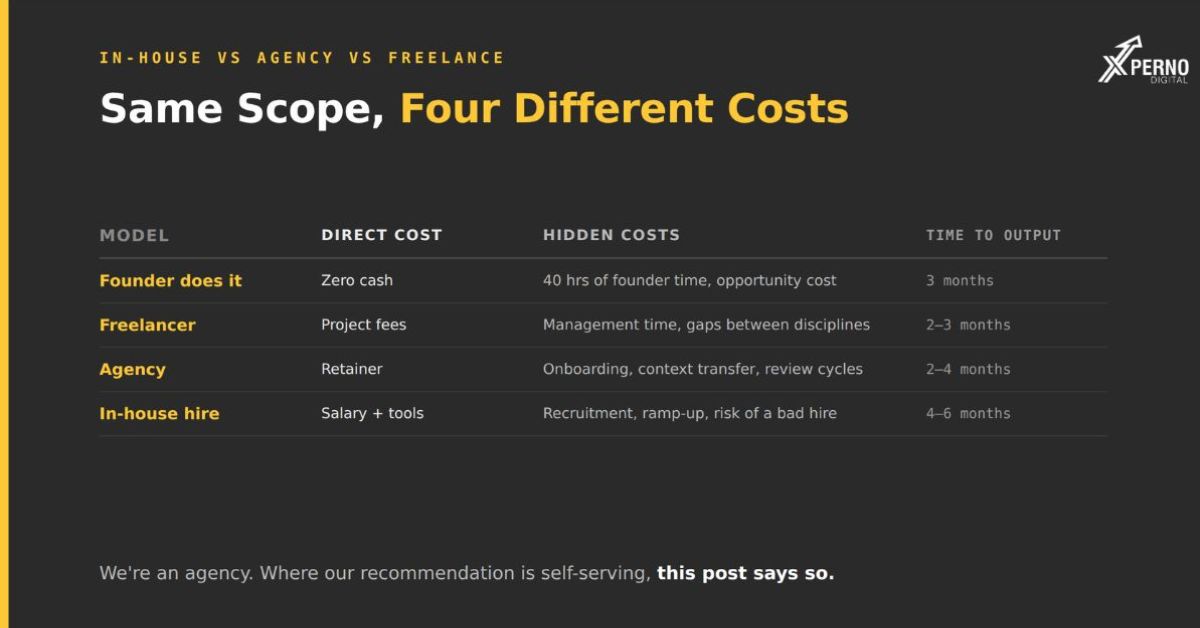
A worked comparison for the same scope build the bottom-of-funnel set, fix technical, establish measurement, run distribution for six months:
- Direct cost: Hidden costs Time to output.
- Founder does it: Zero cash 40 hrs of founder time, opportunity cost 3 months.
- Freelancer: Project fees Your management time, gaps between disciplines 2–3 months.
- Agency: Retainer Onboarding, context transfer, review cycles 2–4 months.
- In-house hire : Salary + tools + management Recruitment, ramp-up, risk of a bad hire.4–6 months.
Costs people underestimate:
Management time: Freelancers and agencies both need direction, review and context. Budget two to four hours a month minimum.
Context transfer: Nobody external starts knowing your category, your competitors or your buyer. The first six weeks are partly education, and that cost is real regardless of model.
Bad-hire risk: An in-house hire that does not work out costs six to nine months and the recruitment cycle. An agency that does not work out costs a notice period.
Opportunity cost of founder time: Forty hours of founder attention is not free, even though it does not appear on an invoice
When should you not hire anyone?
When your positioning is not settled, or when organic is not your constraint.
Two situations where the honest answer is to spend the money elsewhere.
Pre-product-market-fit: If you do not yet know who your ideal customer is or what makes you different, you cannot know what you want to be visible for. Comparison pages require knowing which competitors you beat and for whom. Building visibility for the wrong positioning is worse than building none.
Organic is not the bottleneck: If your problem is that deals stall at proposal, or your close rate dropped, or your sales cycle doubled more organic traffic makes that worse rather than better. Diagnose which constraint is actually binding before buying capacity against a different one.
A useful question to ask any prospective partner: What would make you tell us not to hire you? An inability to answer suggests either no judgement or no willingness to exercise it.
What should you look for in each model?
Different signals matter for each:
In a freelancer: A portfolio of comparable work, direct experience with the specific deliverable, and clarity about what is out of scope. Ask what they will not do.
In an agency: Who is actually doing the work, whether they can name a client engagement that failed and explain why, how they measure AI visibility specifically, and when off-site work begins. Vagueness on the last two is currently the most revealing signal.
In an in-house hire: Whether they have built a system or only run one someone else built. Early hires need to create process, not execute it. Ask about a time they had to decide what not to do.
Across all three: The willingness to tell you something you did not want to hear. It is the most reliable positive signal and the hardest to fake.
Frequently Asked Questions:
At what company size should I hire in-house?
Usually past 50–100 employees, and only when there is sustained, multi-stranded work and an existing system for the hire to run. Below that, a specialist is typically underused.
Can a founder really do this alone?
The foundational work, yes roughly 40 hours across a quarter. It also benefits from knowledge only the founder has. Content volume and distribution outreach are where external capacity helps most.
Is a specialist agency better than a generalist?
For SEO and GEO specifically, usually. Generalist agencies spread across paid, social and organic rarely have depth in any of them.
How long should an agency contract be?
Long enough for the work to produce results this discipline takes months, not weeks. Some lock-in is reasonable; twelve months with no exit and no stated outcomes is a commercial structure rather than a delivery requirement.
What if I hire a freelancer and they leave?
Get documentation as a deliverable. Content, accounts and process should be yours and transferable. Agree this before starting, not after.
Should I use multiple freelancers instead of an agency?
It works if you have the management capacity to coordinate them. Most small teams underestimate that coordination cost — it is effectively a part-time role.