
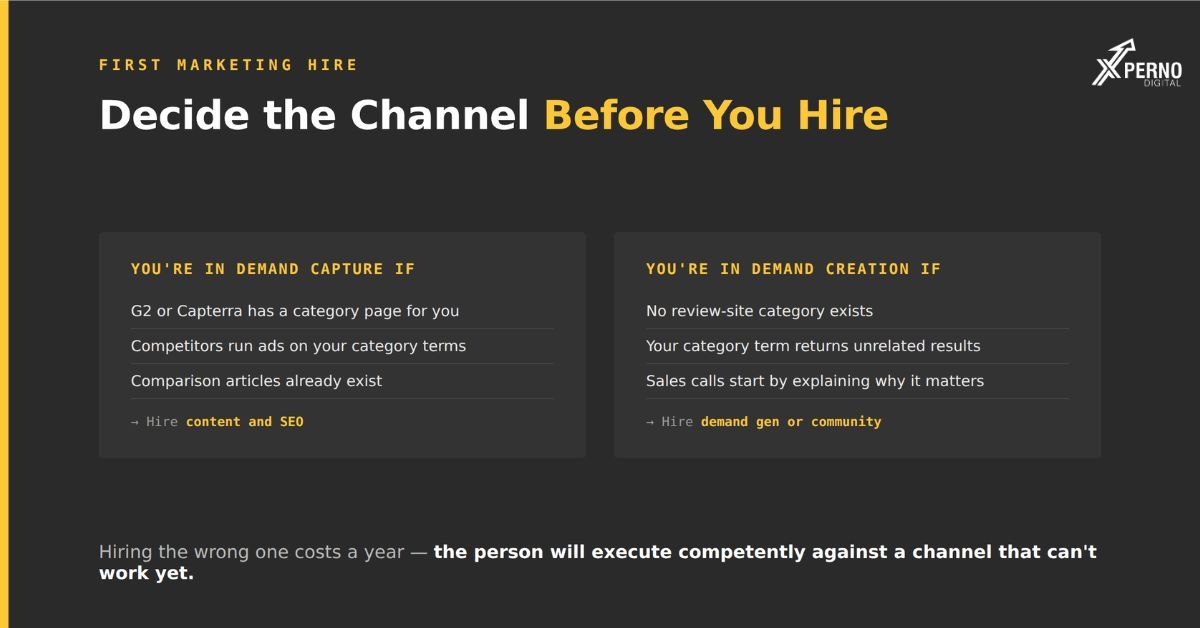
Your first marketing hire should be determined by whether you have a demand capture problem or a demand creation problem a decision the founder must make before hiring, not delegate to the person being hired.
This is the error behind most failed first marketing hires. A founder who is uncertain about channel strategy hires a generalist and hopes they will work it out. The hire arrives with no strategic mandate, no budget authority, and an expectation they will produce pipeline within two quarters.
They spend six months trying everything, nothing compounds, and they leave within a year. The founder concludes marketing hires do not work.
The channel decision comes first. The hire is against that decision.
Demand capture or demand creation?
Demand capture means buyers are already searching for a solution like yours. Demand creation means they do not know the category exists.
You are in demand capture if:
- G2 or Capterra has a category page for what you do
- Competitors run ads on your category terms
- Comparison articles about your category already exist
- Searching your category term returns relevant competing results
You are in demand creation if:
- No review-site category exists
- Searching your term returns unrelated results
- Prospects have no vocabulary for the problem until you give it to them
- Your sales conversations start with explaining why this matters
The ten-minute check: Search the term you would want to rank for. The results tell you which situation you are in immediately.
This determines the hire. Demand capture rewards someone who can intercept existing intent SEO, content, comparison assets, paid search. Demand creation rewards someone who can build awareness where none exists outbound, community, founder-led content, events, partnerships.
Hiring the wrong one costs a year, because the person will execute competently against a channel that structurally cannot work yet
What are the realistic options?
Four archetypes, each suited to a different situation:
The content and SEO hire:
Best for: Demand capture, categories with real search volume, longer sales cycles, considered purchases.
What they do: Build the bottom-of-funnel set, own organic, produce content, manage the site.
Where it fails: In demand creation, where they will publish content nobody searches for. Also fails if leadership expects pipeline in the first quarter organic compounds slowly.
Timeline to impact: Four to eight months.
The demand gen hire:
Best for: Categories with clear intent and budget for paid, where speed matters more than efficiency.
What they do: Paid acquisition, landing pages, conversion, lifecycle, attribution.
Where it fails: With insufficient budget to learn. Paid needs enough spend to find what works, and a small budget spread across channels produces noise rather than signal.
Timeline to impact: One to three months, but the cost stops when the spend stops.
The product marketing hire:
Best for: Unclear positioning, competitive categories, or when sales conversations keep stalling on differentiation.
What they do: Positioning, messaging, competitive intelligence, sales enablement, launches.
Where it fails: When the company needs volume rather than clarity. This hire makes everything else work better and produces no pipeline directly.
Timeline to impact: Two to four months, mostly visible in close rates rather than lead volume.
The generalist:
Best for: Honestly, very few situations but common because it feels safe.
What they do: Everything, at a shallow depth.
Where it fails: They lack depth in whichever channel turns out to matter, and they spread across five channels rather than compounding in one.
When it does work: When the founder has already decided the strategy and needs execution capacity rather than judgement, and when they say so explicitly in the hiring process.
What does the sequence usually look like?
Most companies do best with positioning first, then capture, then scale though the right order depends on which constraint is binding
A common progression:
1. Founder does foundational marketing. Positioning, the bottom-of-funnel content set, early customer conversations. This requires knowledge only the founder has.
2. First hire: whichever channel matches your demand situation. Capture → content and SEO. Creation → demand gen or a community-oriented hire.
3. Second hire: the complement. If you hired content first, add demand gen. If demand gen first, add content.
4. Third hire: product marketing, or sooner if positioning is the binding constraint.
When to break the sequence. If your sales team keeps losing on differentiation rather than on price or features, positioning is the constraint and product marketing comes first regardless of everything else.
What makes first marketing hires fail?
Five failure modes, in order of frequency:
1. The role was sold as strategic and is executional: The most common. The job description says “own our marketing strategy”; the reality is producing content against someone else’s plan. The mismatch surfaces in month three.
2. No budget authority: A demand gen hire with no ad budget, or a content hire with no design or writing support. They can plan but not execute.
3. Expectations mismatched to timeline: Organic takes four to eight months. If leadership expects pipeline in month two, the hire fails against a timeline that was never achievable.
4. No existing foundation: They inherit whatever visibility position you already have. If your brand is absent from the places buyers research, they spend their first two quarters digging out rather than building.
5. They report to someone who does not understand marketing: Common in founder-led companies. The founder wants results but cannot evaluate the work or protect the timeline, so tactics change every six weeks.
The pattern across all five: the failure is structural, decided before the person arrived.
What should you do before hiring?
Four things, roughly a week of work, that make the hire far more likely to succeed:
1. Decide the demand situation: Ten minutes of searching. This decides everything downstream.
2. Build the foundation yourself: The bottom-of-funnel set comparison pages, alternatives, use-case content — requires knowing which competitors appear in deals and what prospects say on calls. That knowledge is expensive to transfer and cheap to use if you already have it. Roughly 25 hours, and it means your hire inherits a working position rather than a blank slate.
3. Write down what the first six months should produce: Specifically. Not “grow the pipeline” but “eight comparison and use-case pages live, organic demo requests from two per month to eight, review velocity from two per quarter to eight per month.” A hire against a vague mandate cannot succeed or be evaluated.
4. Decide the budget before the interview: What can they spend, on what, without asking. A marketing hire with no budget is a marketing plan with no marketing.
Should you hire at all yet?
If your positioning is not settled or organic is not your binding constraint, an agency or freelancer for defined work is usually better than a hire.
Do not hire yet if:
- You do not yet know who your ideal customer is
- Deals stall at proposal rather than at top of funnel the problem is downstream
- You cannot describe what the first six months should produce
- There is no budget beyond the salary
Consider defined external work instead if: you know what needs building but not enough to occupy a full-time person. Six to ten bottom-of-funnel pages plus technical fixes is a project with an end, and a bad project costs weeks rather than the six to nine months a bad hire costs.
The honest test: if you cannot write the six-month outcome specifically enough for someone to succeed or fail against it, you are not ready to hire you are hoping someone will tell you what to do. That is a consulting engagement, not a role.
Frequently Asked Questions:
Should my first marketing hire be senior or junior?
Senior enough to make decisions if you need strategy; junior is fine if you have already decided and need execution. The failure is hiring junior and expecting strategy.
How much should a first marketing hire cost?
Varies by market. The more useful budgeting question is whether you have enough beyond salary for them to actually execute — tools, ad spend, design, freelance writing.
Can a founder keep doing marketing instead?
For the foundational work, yes, and often better. It stops scaling once volume becomes the constraint or when founder time is better spent on sales or product.
What if I need both SEO and demand gen?
Most companies do eventually. Sequence them one hire compounding in one channel beats one person spread across two.
How long before a first marketing hire produces results?
Demand gen: one to three months. Content and SEO: four to eight. Product marketing: two to four, visible in close rates rather than volume.
Should I hire before or after building the content foundation?
After, where possible. A hire inheriting comparison pages and a measurement baseline starts several months ahead of one inheriting nothing.