
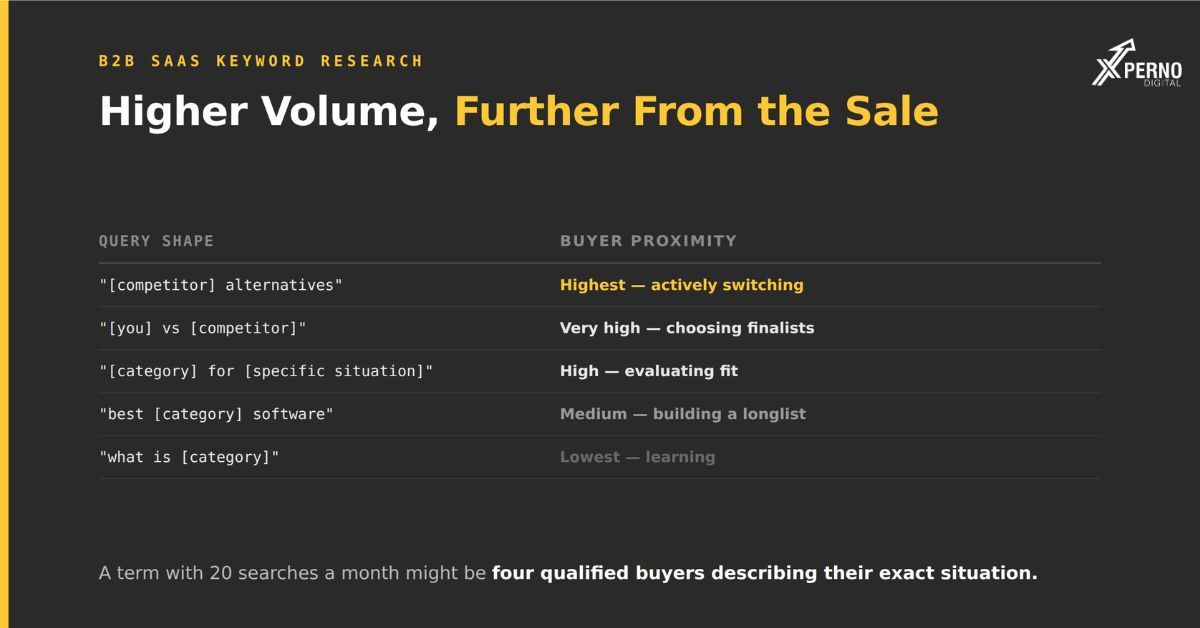
Search volume is the wrong primary filter because B2B purchase decisions are made by small numbers of people, and the queries closest to a purchase have the lowest volume.
A term with 12,000 monthly searches in a B2B category is almost always informational people learning, students, competitors, job seekers. A term with 20 searches a month might be four qualified buyers describing their exact situation.
If your average contract value is $30,000, four qualified buyers is worth considerably more than 12,000 people reading a definition.
This is genuinely different from B2C, where volume correlates reasonably well with commercial value. In B2B the relationship frequently inverts: the higher the volume, the further from a purchase decision.
The practical consequence: Keyword tools optimised for volume will systematically point you at the wrong terms. They are useful for validation and for finding variations, and poor as a starting point.
What should you filter on instead?
Filter on buyer proximity, competitive reality and business fit in that order.
1. Buyer proximity:
How close is someone typing this to making a decision?
- Query shape Proximity Example.
- “[competitor] alternatives” Highest actively switching.
- “[you] vs [competitor]” Very high choosing between finalists.
- “[category] for [specific situation]” High | evaluating fit.
- “[category] pricing” / “cost” High qualifying budget.
- “[category] integration with [tool]” High validating stack fit.
- “Best [category] software” Medium building a longlist.
- “How to [do the job manually]” Low–medium problem aware.
- “What is [category]” Lowest learning
Work top down. Most companies do the reverse, because the bottom of that table has the volume.
2. Competitive reality:
Can you realistically rank, given who is already there?
Look at who occupies the first page. If it is five companies with a decade of accumulated authority plus G2 and Capterra, you are not winning that term this year regardless of content quality.
A quick proxy: If the ranking pages are all category head terms from vendors ten times your size, skip it. If the ranking pages are thin, outdated, or not really about the query, that is an opening.
3. Business fit:
Does ranking for this bring the customers you actually want?
Some high-intent terms bring buyers you cannot serve well wrong size, wrong industry, wrong budget. Ranking for them produces demos that waste your sales team’s time and inflate your CAC.
Be explicit about which segments you want and filter the list accordingly.
Where do the best keywords actually come from?
The best B2B keyword list comes from sales calls, not keyword tools.
This is the single most useful thing in this post and almost nobody does it.
The Method:
Step 1: Get access to twenty sales calls. Recordings, transcripts, or notes. Discovery calls are best.
Step 2: Extract how prospects describe their situation. Not what your team calls it. What they call it.
You are listening for:
- How they name the problem before they know your category exists
- What they were using before, and what broke
- The specific constraint that triggered the search
- The words they use for their own company type and size,
Step 3: Write those phrasings down verbatim. These are your queries.
What this produces. Your team says, “field service management platform.” Prospects say “software for scheduling HVAC techs” and “something to stop double-booking my guys.” Your team says “revenue intelligence.” Prospects say “know which deals are actually going to close.”
The prospect phrasings have lower volume and vastly higher intent, and your competitors are almost certainly not targeting them because they did not come out of a keyword tool.
Step 4: Validate, do not originate, with tools. Once you have the phrases, use a keyword tool to find variations and check whether anything has meaningful volume. Do not start with the tool.
What is the modifier layer?
The modifier layer is your category term plus a qualifier that narrows it to a specific buyer and it is where a smaller company can actually win.
- Head term (skip) | Modified term (target).
- Project management software | Project management for architecture firms.
- CRM software | CRM for field service teams under 50.
- Help desk platform | Help desk software with Slack integration.
- Accounting software | Accounting software for SaaS revenue recognition.
- Inventory management | Inventory management for multi-warehouse ecommerce.
Why these work: Incumbents write for everyone. Their category page has to serve a 20-person company and a 2,000-person enterprise, which means it serves neither specifically. The modified query is frequently unaddressed by anyone.
The four modifier types worth systematically working through:
- Industry: For architecture firms, for HVAC contractors, for law firms
- Company size: For teams under 50, for enterprise, for solo operators
- Integration: With Slack, with QuickBooks, with Salesforce
- Job: For scheduling, for compliance reporting, for multi-site inventory
Take your category term, apply each modifier type, and you have thirty to sixty candidate queries. Filter them against your sales-call language and you have your list.
How does this change for AI search?
The same list serves both, because AI queries are closer to how buyers speak than to how they search.
People type fragments into Google and sentences into an AI interface. “crm field service small team” becomes “we’re a 40-person HVAC company using spreadsheets, what CRM should we look at.”
Which means the sales-call method matters more, not less? The phrasings you extract from discovery calls are already conversational. They map more directly onto AI prompts than onto search queries.
One practical addition: When you build your keyword list, write each entry twice once as a search query and once as a conversational prompt. Test the second version in ChatGPT and Perplexity as part of your monthly measurement.
How do you organise the list?
Group by page rather than by keyword, and accept that one page targets a cluster of related queries.
A common failure is a keyword list with 400 rows and no clear mapping to pages, which produces either 400 thin pages or paralysis.
A workable structure:
- Page Primary query Secondary queries
- Comparison: you vs Competitor A | “[you] vs [A]” | “[A] vs [you]”, “difference between [you] and [A]” |
- Alternatives to Competitor A | “[A] alternatives” | “similar to [A]”, “[A] competitors” |
- Use case: architecture firms “[category] for architecture firms” | “project management for architects”, “[job] software for design studios”
- Integration: QuickBooks “[you] QuickBooks integration” “[category] that works with QuickBooks”
Eight to fifteen pages covering thirty to fifty queries is a realistic first list for a small team. Not four hundred.
What about volume-zero keywords?
Terms showing zero volume in keyword tools are frequently worth targeting, because tools underreport low-volume B2B queries.
Keyword tools round down, sample imperfectly, and have poor coverage of niche B2B language. A term reported as zero may have ten to thirty real monthly searches which in a category with a $30,000 contract value is a meaningful number.
When to target a zero-volume term:
- It came from an actual sales call, so you know at least one person used it
- It has clear buying intent
- Nobody has a dedicated page for it
- It fits a page you were building anyway
When not to? When it exists only because a tool suggested it and you have no evidence anyone has ever typed it.
The sales-call origin is what distinguishes a valuable zero-volume term from a fictional one.
Frequently Asked Questions:
Do I need a paid keyword tool?
Not to start. Sales-call language plus the modifier framework produces a usable list. Add a tool for validation and variation discovery once you have the foundation.
How many keywords should I target?
Thirty to fifty queries mapped to eight to fifteen pages is a realistic first list for a small team. Large lists produce either thin pages or inaction.
Should I target competitor brand terms?
Yes , “[competitor] alternatives” and “[you] vs [competitor]” are among the highest-intent queries available. This is standard practice in B2B software.
What if my category has no search volume at all?
You may be in demand creation rather than demand capture, which makes SEO the wrong primary channel. Check whether review sites have a category page and whether competitors run ads on the term.
How often should I revisit the keyword list?
Quarterly, and after any significant number of new sales calls. New objections and new phrasings surface constantly.
Do keyword tools work for AI search?
Not directly. Build the list from buyer language, then write each entry as both a search query and a conversational prompt, and test the second version monthly.