
Independent “best [category] tools” articles are the most frequently cited source type when AI engines answer B2B software recommendation queries.
The reason is structural. A system assembling a recommendation needs to weigh options against each other, using sources it can attribute. A roundup has already done that work multiple vendors, compared, with reasoning, from someone who does not sell any of them.
That combination is close to ideal input, which is why these articles appear in citations far more often than vendor content does.
The encouraging part: The publications cited are frequently not major outlets. Mid-authority trade sites, category-specific blogs and industry newsletters appear constantly. You do not need coverage in a national publication. You need to be in the places that actually write about your category.
The durable part: A roundup inclusion has a multi-year shelf life. Unlike a campaign, it keeps working.
Which roundups actually matter?
The ones that appear in AI citations for your category which you can identify in about an hour rather than guessing.
Most roundup outreach fails because it targets whatever ranks on page one of Google, which is a proxy rather than the thing itself.
The method:
Step 1: Run ten to fifteen buyer prompts in Perplexity. It displays its sources.
Step 2: Record every cited URL All of them, not just the ones you recognise.
Step 3: Filter for roundup articles. Third-party pieces comparing multiple vendors.
Step 4: Count frequency. Which articles appear repeatedly?
What you typically find: Three to eight articles account for most roundup citations in a category. Often one or two account for a disproportionate share.
That is your target list: Not fifty publications five or eight, prioritised by how often they actually feed answers in your market.
Then check where you stand: Are you in each one? Described accurately? Positioned in a segment that suits you?
What do you actually send?
Send something useful to the author before you ask for anything.
The standard approach an email asking for inclusion, describing your product, listing your features has a very low success rate because it asks the author to do work for your benefit.
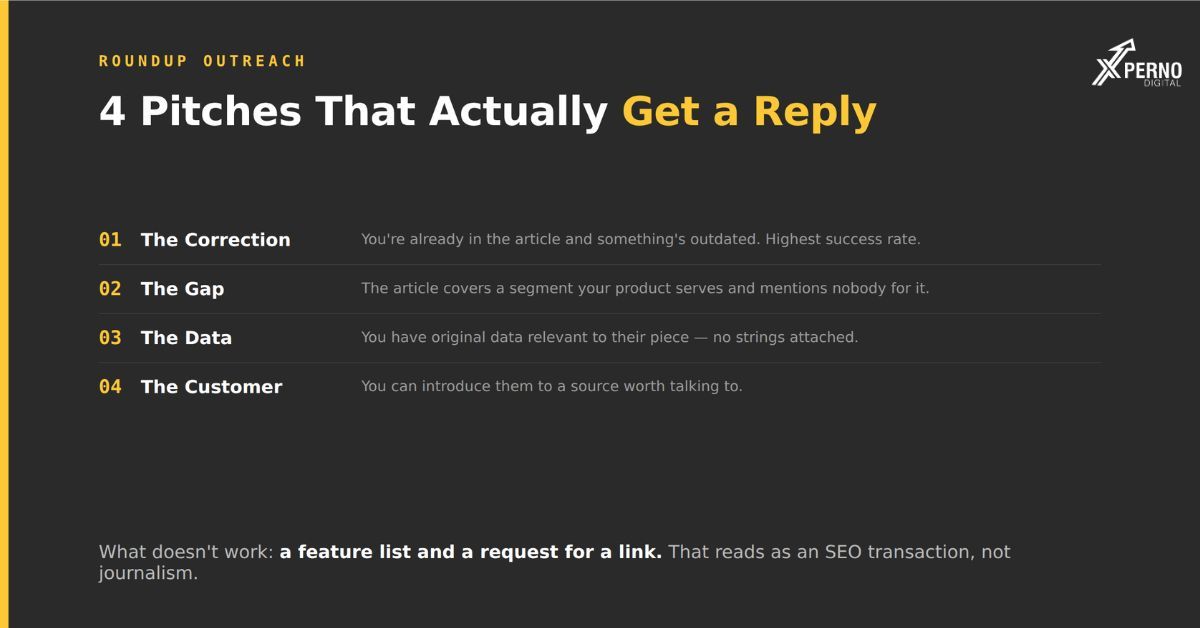
Four approaches that work better, in order of success rate:
1. The correction:
You are already in the article, and something is wrong. Old pricing, a feature you have added, a discontinued capability listed as current.
Subject: Correction for your [category] roundup [Product] pricing
Hi [name],
Your [category] comparison lists [Product] at $89/user. We moved to $49/user in March, with a five-seat minimum.
Pricing page here if useful: [link]
Thanks for including us either way.
Why it works: You are helping them be accurate. Success rate is high most publishers will fix a factual error when you make it easy.
2. The gap:
- The article covers a segment your product serves and does not mention any option for it.
- Hi [name],
- Your roundup covers [category] well for larger teams. One gap worth flagging: nothing in the list handles [specific situation] [Competitor A] requires [constraint] and [Competitor B] doesn’t support [thing].
- We built [Product] specifically for that case. Happy to send details if it’s useful for a future update, or to point you at a customer who could speak to it.
Why it works: It identifies a genuine hole in their coverage rather than asking for a favour.
3. The data:
- You have original data relevant to their article.
- Hi [name],
- We ran [specific test] across [sample] and found [specific finding]. Full method here: [link].
- Thought it might be useful for your [category] piece use it however you like, no attribution needed.
Why it works?: journalists and trade writers need statistics. Offering one with no strings is genuinely valuable, and attribution usually follows anyway.
4. The customer:
- You can introduce them to a customer worth talking to.
- Hi [name],
- Saw your piece on [topic]. One of our customers runs [interesting situation] and has strong views on [subject]. Happy to introduce if you’d find that useful no expectation of a mention.
Why it works?: Sources are harder to find than products.
What not to do?:
Five approaches that fail reliably:
Paid placement in “best of” lists: Some sites sell inclusion. It is usually disclosed, which reduces its weight as an independent source, and it is precisely the kind of thing that undermines the credibility you were buying.
Mass outreach: Fifty generic emails to a scraped list produces near-zero responses and can get your domain flagged. Ten specific, researched approaches produce more.
Asking for a link: Ask for accuracy or inclusion. Framing it as a link request signals SEO transaction and gets ignored by editorial writers.
Following up more than twice: Once after a week, once after three. Then stop.
Complaining about a competitor’s placement: Never works, damages the relationship, and makes you look insecure.
How do you find the author?
The byline, then LinkedIn, then the publication’s editorial contact in that order.
Many roundups have no byline or a generic “team” attribution. In those cases look for an editor or content lead on LinkedIn or use the publication’s editorial contact rather than a general sales address.
On the pitch itself: keep it under 120 words, put the specific value in the first sentence, and do not attach anything. Links only.
What about roundups you cannot get into?
Build your own comparative content and get into the sources that feed the roundup writers.
Some articles will not update, some publications have commercial arrangements, and some writers do not respond. That is normal.
Two indirect routes:
Publish your own comparison and alternatives content. These get cited directly, and roundup writers use vendor comparison pages as research when compiling their articles. Your page influences articles you did not write.
Build review platform presence: Roundup writers routinely start with G2 and Capterra to build their candidate list. A vendor with 40 recent reviews is far more likely to be considered than one with three.
The second point is worth emphasising: Getting into roundups is partly downstream of review presence. Working on both simultaneously compounds.
How long does this take?
Four to six months from outreach to measurable effect.:
Weeks 1–2: Identify the target articles from your citation analysis. Find the authors.
Weeks 3–6: Send ten to fifteen specific approaches. Expect two to four responses.
Months 2–4: Corrections publish quickly, usually within weeks. New inclusions typically wait for the article’s next update cycle, which is often quarterly or annual.
Months 4–6: Updated articles get recrawled and start appearing in citations.
What to expect from ten approaches? Two to four responses, one to three corrections or inclusions. That sounds modest until you consider that each inclusion works for years and appears in a source type that dominates AI citations.
How to track it? Re-run your buyer prompts monthly and check whether the target articles now include you and whether they still appear in citations. This is also how you find out when an article stops being cited, which tells you to reprioritise.
Frequently Asked Questions:
Should I pay for inclusion in a roundup?
Generally no. Paid placements are usually disclosed, which reduces their weight as independent sources, and the value was in the independence.
How do I find roundups in my category?
Run buyer prompts in Perplexity and record which articles it cites. That identifies the ones actually feeding answers, rather than the ones that merely rank.
What if I’m in the article but described badly?
That is the easiest fix on this list. A polite correction with a link to your source page has a high success rate.
How many roundups should I target?
Five to eight, chosen by citation frequency. Depth beats breadth a correction to a frequently-cited article is worth more than inclusion in five that nobody cites.
Do smaller publications matter?
Yes, often more than expected. Mid-authority trade sites and category-specific blogs appear frequently in citations, and they are considerably more responsive to outreach.
What if the article hasn’t been updated in two years?
Lower priority. Check whether it still appears in citations some old articles remain heavily cited, in which case a correction is still worth sending.