
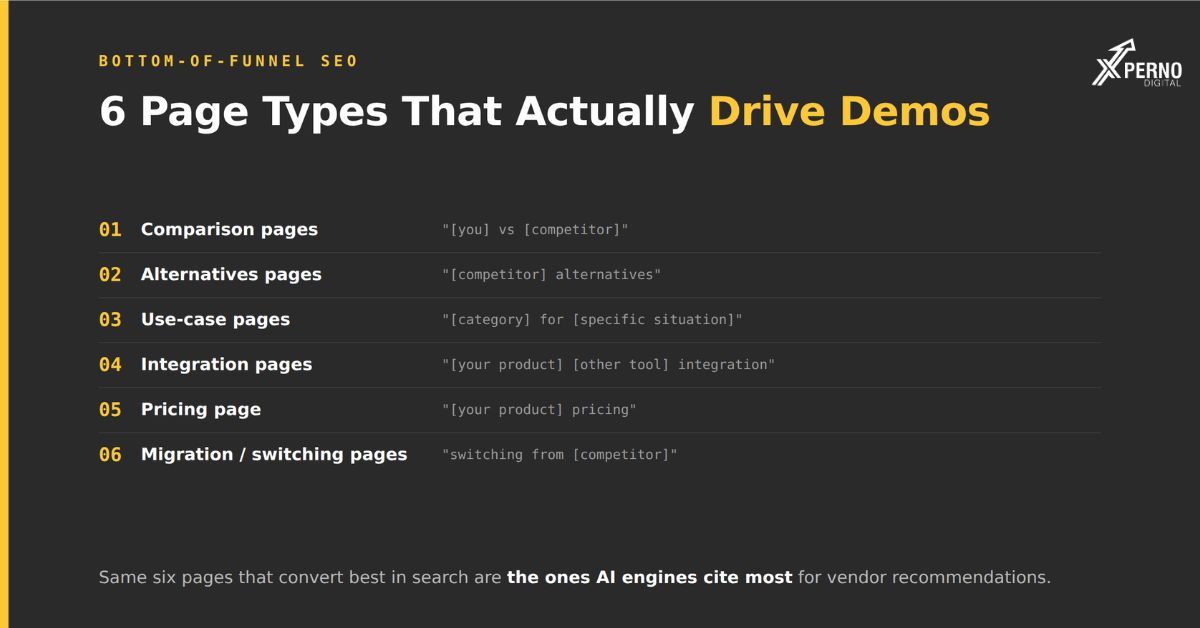
Bottom-of-funnel SEO means building pages that capture people already evaluating a purchase, rather than people learning about a category.
The distinction is not about content quality. It is about where the searcher is.
Someone searching “what is field service management software” is learning. They may buy in six months, or never. Someone searching “Service Titan alternatives for small contractors” has a budget, a timeline and a problem with their current vendor.
The second person is worth vastly more, and the page that serves them takes three hours to write.
Why this matters more than it used to?: Bottom-of-funnel pages are also the content types AI engines cite most heavily for vendor recommendation queries. The same six pages that convert best in search are the ones that get you named in AI answers. That convergence did not exist five years ago, and it is why the standard “build awareness content first” advice has aged badly.
Why build these before blog content?
Bottom-of-funnel pages convert at several times the rate of blog content, are a finite build rather than an ongoing commitment, and target queries with far less competition than category head terms.
Three reasons, in order of practical importance:
They are finite: Six to ten pages. Built in a month, updated quarterly, working for years. A content calendar is a treadmill; this is a project with an end.
They convert: A comparison page reaches someone choosing between two named vendors. A blog post about industry trends reaches someone who may not be in market at all.
They face less competition: Everyone writes explainer content. Far fewer companies build comparison pages, because naming competitors feels uncomfortable which leaves the highest-intent queries in your category underserved.
The counterargument is that top-of-funnel builds awareness and fills the pipeline over time. That is true, and it is a reasonable second priority. It is a poor first priority for a company that needs pipeline this quarter.
What are the six page types?
Six page types make up the bottom-of-funnel set, in order of value.
1. Comparison pages: You vs each main competitor:
Query: “[you] vs [competitor]”
Buyer state: Choosing between two finalists
The highest-value page you can build. Contains the comparative claims buyer queries require, and it is the most-cited content type in AI vendor recommendations.
What makes one work?: Checkable facts rather than adjectives, and explicit acknowledgement of where the competitor genuinely serves someone better. That concession is what makes every other claim on the page credible.
How many?: One per competitor that actually appears in your deals. Pull your last fifty won and lost deals and count. Usually three or four.
2. Alternatives pages: for your largest competitor:
Query: “[competitor] alternatives”
Buyer state: Already decided to switch
The highest commercial intent query in B2B software. Someone asking it has a budget and a reason.
The mistake: Listing only yourself. A page offering one option does not answer a query asking for alternatives, and readers see through it immediately. List five to seven genuine options, describe each fairly, present yourself in the same format as everyone else.
How many?: One to three. These are maintenance-heavy you are publishing facts about six other companies, all of which change.
3. Use-case pages your product for a specific job:
Query: “[category] for [specific situation]”
Buyer state: Researching whether you fit their exact case
Not “project management software” but “project management for architecture firms under 50 people.”
Why these win?: Incumbents write for everyone, which leaves specific situations unserved. Lower volume, dramatically higher intent, and frequently no dedicated page exists from anyone.
How to find them?: Your own sales calls. The way prospects describe their situation is the query. Ask your sales team what people actually say.
How many?: four to eight, covering your main segments.
4. Integration pages: Your product plus tools they use:
Query: “[your product] [other tool] integration”
Buyer state: Validating that you fit their existing stack.
Consistently underbuilt and consistently searched. A buyer with an existing stack needs to know you connect to it before anything else matters.
What to include?: What the integration actually does, what data flows which way, what it does not do, setup requirements.
How many?: One per meaningful integration. Ten to thirty is normal for a mature product, and these can be templated.
5. Pricing page indexable and specific:
Query: “[your product] pricing”, “[category] cost”
Buyer state: Qualifying whether you are in budget
The gating problem: If your pricing exists only behind a form, no extractable price fact exists about your product anywhere — which removes you from every AI query comparing options on cost, and from a large volume of search.
Gating remains a legitimate commercial choice. The cost has simply gone up, and most companies have not repriced that trade-off recently. At minimum, publish the structure and a starting figure.
6. Migration and switching pages:
Query: “Migrate from [competitor] to [you]”, “switching from [competitor]”
Buyer state: Decided to move, worried about the process
The most overlooked page type: A buyer who has decided to switch is now worried about data loss, downtime and disruption. A page answering those concerns removes the last obstacle.
What to include: What transfers and what does not, typical timeline, what breaks, who does the work.
In what order should you build them?
Build comparison and alternatives pages first, then use-case, then the rest.
Priority Page type Count | Hours each.
1 Comparison: 3–4 / 3–4 |
2 Alternatives: 1–2 /4–5 |
3 Use-case: 4–8 /2–3
4 Pricing (make indexable): 1 / 2
5 Integration: 10–30 / 1–2, templatable.
6 Migration: 1–3 / 3
The first two priorities are about 20 hours and produce most of the return. If capacity is limited, stop there and revisit later
How do you write one that converts and gets cited?
The same structural rules serve both: answer the question directly, use checkable facts, and be honest about limitations.:
Answer-first structure: Every heading a question a buyer would ask, answered completely in the first sentence beneath. This is what makes a claim extractable by an AI engine and what makes the page scannable for a buyer who has read six of these already today.
Checkable facts, not adjectives: “Starts at $49 per user per month, minimum five seats” is usable. “Flexible pricing that scales with you” is not by a buyer or a model.
Honest limitations: Name where a competitor is better, who your product is not for, what the integration does not do. This is the single largest credibility lever available, and it is uncomfortable enough that most competitors will not use it.
Currency: These pages contain facts about other companies’ products. An outdated comparison is worse than no comparison, because being demonstrably wrong about a checkable fact undermines the whole page. Quarterly review, visible last-updated date.
What results should you expect?
Comparison and alternatives pages typically show AI citation in eight to fourteen weeks and organic ranking in four to eight months.
Citation moves first: These pages directly match how buyer queries are phrased, and competition for the specific comparison is often thin.
Ranking takes longer: Competitor-branded queries are contested you are competing against the incumbent’s own pages, review platforms and established roundups, and your page starts with no authority.
Conversion is immediate for the traffic that arrives: These pages typically convert at multiples of blog content, because the visitor is already evaluating.
What to measure: Run “[you] vs [competitor]” and “[competitor] alternatives” through ChatGPT and Perplexity monthly. Track whether your page is cited and whether you are named in the answer. In search, track ranking for the branded comparison terms and conversion rate on the pages themselves.
Frequently Asked Questions:
Is it legal to name competitors on my website?
Comparative advertising using factual, substantiated claims is standard practice in B2B software in most jurisdictions. Avoid unsubstantiated claims and trademark use implying endorsement.
Won’t comparison pages send traffic to competitors?
Some. But the visitor was already comparing you both. A page where they find balanced information from you beats one where their only source is your competitor’s version.
How many bottom-of-funnel pages do I need?
Six to ten covers most companies. Three comparison, one alternatives, four use-case is a strong minimum.
Should I build these before or after fixing technical SEO?
Run the basic technical checks first they take an hour. Then build these. Comprehensive technical audits can wait.
Do integration pages really drive demos?
They drive qualified traffic from buyers validating fit. Conversion per visit is lower than comparison pages but volume is higher and they are cheap to produce.
What if I have no direct competitors?
Compare against the incumbent process instead spreadsheets, a manual workflow, an internal build. “Alternatives to managing this in spreadsheets” is a real query with almost no competition.