
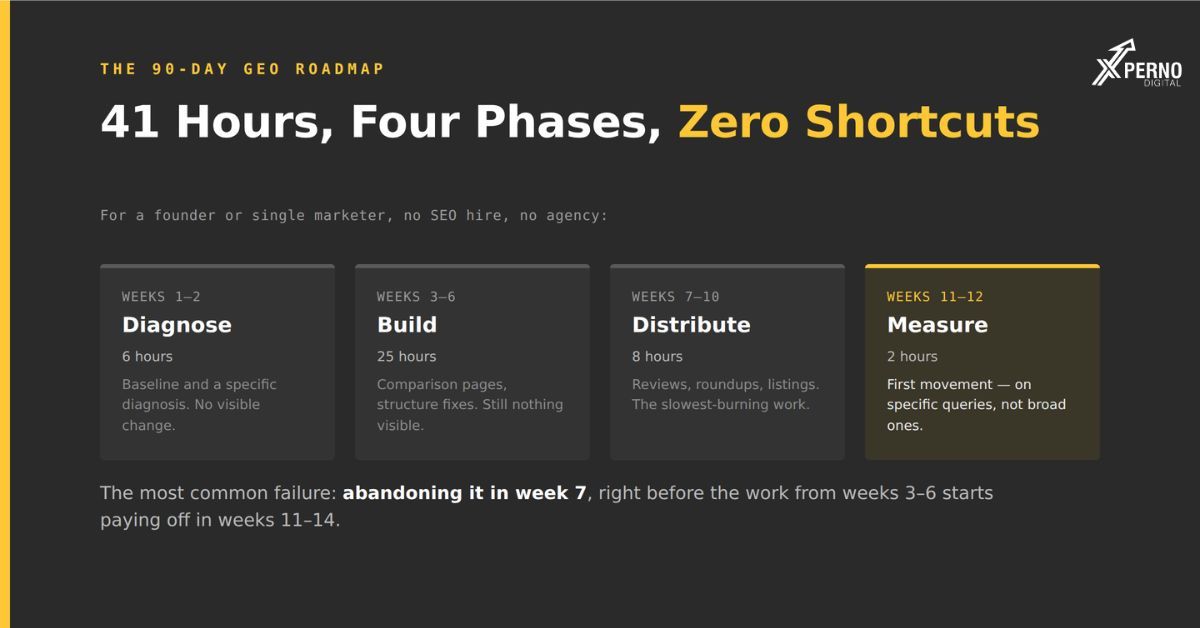
A realistic 90-day GEO plan is roughly 40 hours of work concentrated in the first six weeks, followed by maintenance and it produces movement on specific queries by around week twelve, not on broad category queries.
The plan below assumes a founder or single marketer with no SEO specialist, no agency, and limited time. It is scoped to that reality rather than to what a five-person content team could execute.
One thing to be clear about before starting: The first eight weeks produce no visible movement. That is not a sign of failure, it is how the mechanism works. Content has to be built, crawled and incorporated before anything changes. Knowing this in advance is what prevents abandoning the work in week seven.
Weeks 1–2: Diagnose:
Time: 6 hours. Output: a baseline and a specific diagnosis.
Week 1 : Establish where you stand
Build your prompt set (1 hr): Fifteen to twenty buyer-intent prompts covering four types: core buying questions, comparisons, alternatives to competitors, and direct brand queries. Write them in buyer language, not marketer language. Freeze the wording.
Run them (2 hrs): Chat GPT, Perplexity and Google AI Overviews. Fresh session every time. Record which brands appear, in what order, and critically every cited URL from Perplexity.
Calculate your baseline: Appearance rate and share of voice. These are the numbers you will measure against for the next year.
Week 2: Find the cause
Analyse the citation pattern (1 hr): Group every cited URL by source type. Which two or three dominate your category? That is where your off-site effort belongs.
Run the technical checks (1 hr): Robots.txt for blocked AI crawlers. CDN and WAF settings. Whether documentation is indexable. Whether pricing exists anywhere extractable. Whether key content is server-rendered.
Check accuracy (1 hr): Ask the engines to describe your product and check every factual claim. Wrong pricing, discontinued features, wrong category. If you find errors, they move to the front of the queue amplifying a wrong description makes things worse.
What you should have: A specific diagnosis. Not “we need more content” but something like “we are absent from all comparison queries because no comparative content about us exists anywhere; the three cited competitors each appear in four trade roundups we are missing from; and our G2 profile has three reviews, none since 2023.
Weeks 3–6: Build:
Time: 25 hours. Output: the assets that produce everything downstream.
This is the bulk of the work and the phase where nothing visible happens.
Weeks 3–5: Comparison and alternatives content
Four to six pages, 3–4 hours each.
Choose competitors by frequency in your actual deals, not by market size. Pull your last fifty won and lost deals and count which names appear.
- One comparison page per top competitor (3–4)
- One alternatives page for the largest
- Optionally, one for the non-product incumbent spreadsheets, a manual process, an internal build
Non-negotiable on each page: Name the segment where the competitor genuinely serves someone better. This is uncomfortable and it is what makes everything else on the page credible.
Week 6 : Structure and facts
Extractable facts (3 hrs): State plainly, in crawlable text: what the product does, who it is for, what it costs, what it integrates with, what it does not do.
Answer-first restructuring (3 hrs): Take your five most important pages. Turn every heading into a question a buyer would ask. Rewrite the first sentence under each so it answers completely and independently.
Schema (2 hrs): Organization with a complete `same As` array. Software Application with a pricing offer. FAQ Page where you genuinely answer questions.
Technical fixes: Whatever the week 2 check surfaced
Weeks 7–10: Distribute:
Time: 8 hours across four weeks. Output: the slowest-burning and most durable component.
Start this now even though nothing has moved yet, because it has the longest lead time. Outreach in week seven produces coverage in month five.
Review platform system (1 hr setup, then 15 min/week): Two platforms, chosen by what Perplexity actually cites in your category. Automate requests triggered by successful onboarding, resolved support tickets and renewals. Ask everyone, not selectively.
Roundup outreach (4 hrs): Take the roundup articles from your week 2 citation analysis. Contact the authors with something useful a correction if you are described wrongly, a data point, or a specific case for inclusion. Ten targeted approaches beat fifty generic ones.
Listing consistency (2 hrs): Audit every third-party listing you control G2, Capterra, Crunchbase, LinkedIn, directories. Make the category description identical everywhere, matching your canonical description.
Weeks 11–12: Measure and adjust:
Time: 2 hours. Output: evidence of what is working.
Re-run the prompt set: Same prompts, same phrasing, fresh sessions. Compare against your week 1 baseline.
What you should see: Movement on alternatives queries and direct brand queries. Possibly on specific use-case prompts. Appearance rate up by a few prompts out of twenty.
What you should not see: Movement on broad category queries. Those take six to twelve months and in entrenched categories may never move. If your report treats this as failure, the expectations were set wrong.
Adjust based on what moved: If alternatives queries moved and comparisons did not, your comparison pages may need more specific facts. If nothing moved at all, recheck the technical basics a blocked crawler discovered in week twelve is a painful but common finding.
The whole plan at a glance:
- Weeks: Focus Hours Visible result.
- 1–2 Diagnose: 6 None you have a baseline.
- 3–6 Build: comparison content, fix structure 25 None.
- 7–10 Distribution: reviews, roundups, listings 8 None.
- 11–12 Measure: 2 First movement on specific queries.
- Total 41 hrs.
Forty-one hours across ninety days is roughly three and a half hours a week. That is achievable alongside a founder’s actual job.
What happens after day 90?
Maintenance is about four hours a month, and the compounding starts around month four:
- Monthly (1 hr): Re-run the prompt set. Update the tracking sheet.
- Monthly (2 hrs): Continued roundup outreach and community participation.
- Monthly (15 min): Review request flow.
- Quarterly (2 hrs): Update comparison pages competitor pricing and features change, and an outdated comparison is worse than none.
- Months 4–6: Is where the distribution work from weeks 7–10 lands. Review presence accumulates, roundup inclusions publish, share of voice starts moving rather than just appearance rate.
- Months 6–12: Is where broader queries become contestable, in categories where they are contestable at all.
What not to do?
Do not start with blog content: Explainer posts are the least-cited content type for vendor recommendation queries and the most competitive in search. If you have limited hours, comparison pages return more.
Do not target broad category terms: “Best CRM software” is dominated by companies with a decade of accumulated authority. Your effort goes to specific, situational queries.
Do not spend week 1 on a technical audit: Run the five basic checks and move on. Comprehensive audits absorb time that belongs elsewhere, and small sites rarely have problems severe enough to justify it.
Do not skip the distribution weeks because nothing has moved: They have the longest lead time. Skipping them in week seven means nothing lands in month five.
Do not change your prompt wording between months: You lose the comparison entirely.
Do not abandon in week seven: This is the most common failure. The work in weeks 3–6 is what produces the movement in weeks 11–14. Stopping before then means paying the full cost and collecting none of the return.
Frequently Asked Questions:
Can a founder really do this alone?
Yes, at roughly 41 hours across 90 days. The scope is deliberately narrow four to six pages, two review platforms, ten outreach approaches rather than a full content programme.
What if I only have half that time?
Do weeks 1–2 and weeks 3–5. Diagnosis plus comparison pages is roughly 20 hours and produces most of the return. Add distribution when you can.
Do I need any paid tools?
No. The plan needs a browser and a spreadsheet. Add tooling when a specific bottleneck justifies it.
What if the diagnosis shows we’re already visible?
Then this is not your most urgent problem. Recheck quarterly and spend the 41 hours on whatever your actual constraint is. That is a legitimate outcome of week 1.
When should I bring in help?
When the comparison pages exist and you need content volume, or when distribution outreach becomes the bottleneck. Not before the foundational work is the part a founder does best, because it requires knowing the market.
What if nothing has moved by week 12?
Recheck the technical basics first, particularly crawler access. Then check whether the comparison pages contain specific, checkable facts rather than adjectives. If both are sound, your category may be one where movement takes longer.