
Perplexity retrieves live web results for a query, then selects the sources that contain extractable, relevant claims it can attribute favouring pages that answer the specific question directly over pages that rank well generally.
Its architecture is more transparent than most. It runs a search, retrieves a set of candidate pages, reads them, and synthesises an answer with numbered citations pointing at the pages it used.
Because it displays those citations, Perplexity is the single most useful engine for diagnosing your AI visibility. It tells you not just whether you appeared, but which pages the engine consulted and therefore where the gap is.
This makes it the right engine to start with, even if ChatGPT has more users. You cannot fix what you cannot see, and Perplexity is the only major engine that shows it’s working.
Why is Perplexity the best diagnostic tool?
Because the citation list tells you which sources dominate your category, which is more actionable than knowing whether you appeared.
Run a buyer-intent prompt and you get two pieces of information :
Whether you were named: Useful, and available from any engine.
Which URLs it consulted: Available only here, and considerably more useful.
Over ten to fifteen prompts, a pattern emerges. Three or four source types will account for most of the citations in your category. Perhaps it is heavily weighted to G2 and two trade publications. Perhaps it is Reddit and vendor documentation. Perhaps a single well-ranked roundup article is responsible for a third of everything.
That pattern is your distribution strategy. Not the general advice about third-party presence the specific list of places that actually feed answers in your market.
Most companies never run this check, which is why most off-site effort is spread evenly rather than concentrated where it matters.
What kinds of pages get cited?
Pages that answer the specific question asked, contain checkable facts, and are recent enough to be current.
Five characteristics that recur:
- Direct relevance to the query, not the topic: A comprehensive guide to project management software is less likely to be cited for “best tool for a 50-person agency” than a narrower page addressing that exact situation. Specificity beats comprehensiveness here.
- Extractable claims: A page containing “starts at $49 per user per month” gives the engine something to use. A page containing “flexible pricing designed to scale with you” does not.
- Comparative framing: Buyer queries are comparative. Pages that only describe one product cannot answer them.
- Recency: Perplexity leans on live retrieval, which means it favours current content more heavily than engines relying on trained knowledge. A page updated three months ago frequently outperforms a more authoritative page from 2022.
- Reasonable search visibility: Perplexity retrieves before it reads. A page that ranks nowhere is unlikely to enter the candidate set. This is where traditional SEO still matters not because ranking equals citation, but because ranking is how you get considered.
How is it different from ChatGPT?
Perplexity relies more heavily on live retrieval; ChatGPT blends trained knowledge with retrieval depending on the que
- Perplexity ChatGPT
- Primary mechanism Live retrieval Trained knowledge + retrieval
- Shows sources Always When browsing
- Responds to new content Weeks Weeks (retrieval) / model release (trained)
- Favours Recency and specificity Established, repeated presence
- Best for Diagnosis Reach
What the divergence tells you? If you appear in Perplexity but not ChatGPT, you likely have recent coverage but little established, repeated presence across the web you are new to the conversation. If the reverse, your historical presence is good, but your current content is not being retrieved, which often points to a crawler or freshness problem.
Absent from both is the simplest diagnosis and the largest project.
How do you become a cited source?
Build pages that answer specific buyer questions directly, keep them current, and be present on the sources Perplexity already cites in your category:
Step 1: Find out what it currently cites: Run ten to fifteen buyer prompts and record every cited URL. Group them by type: review platforms, roundups, vendor pages, community, documentation.
Step 2: Concentrate on the dominant two or three: If trade publication roundups account for 40% of citations in your category, that is where outreach effort belongs. If it is overwhelmingly Reddit, community participation matters more than it would elsewhere.
Step 3: Build the pages that answer the specific questions: Take your prompt set and check whether you have a page that directly answers each one. Most companies find they have content adjacent to the question and nothing that answers it.
Step 4: Make claims extractable: Question-based headings, complete answers in the first sentence, specific facts rather than adjectives.
Step 5: Keep it current: Perplexity favours recency more than other engines. A visible last-updated date and genuine quarterly review of your key pages is worth more here than anywhere else.
Step 6: Maintain baseline search visibility: Pages that rank nowhere rarely enter the candidate set. Traditional SEO fundamentals remain the entry ticket.
Does Perplexity actually matter for B2B?
Perplexity has fewer users than ChatGPT but a research-heavy audience, which over-indexes on people evaluating software.
The user base skews toward people doing deliberate research rather than casual queries analysts, consultants, technical buyers, people comparing options. That is disproportionately your buyer.
The honest assessment: Even setting aside its own user base, Perplexity earns attention as a diagnostic instrument. The citation display is the closest thing available to a window into how these systems choose sources, and what you learn there generally transfers to engines that do not show their working.
If you only test one engine monthly, test this one. If you optimise for one, do not optimise for the underlying characteristics all of them reward.
What should you do first?
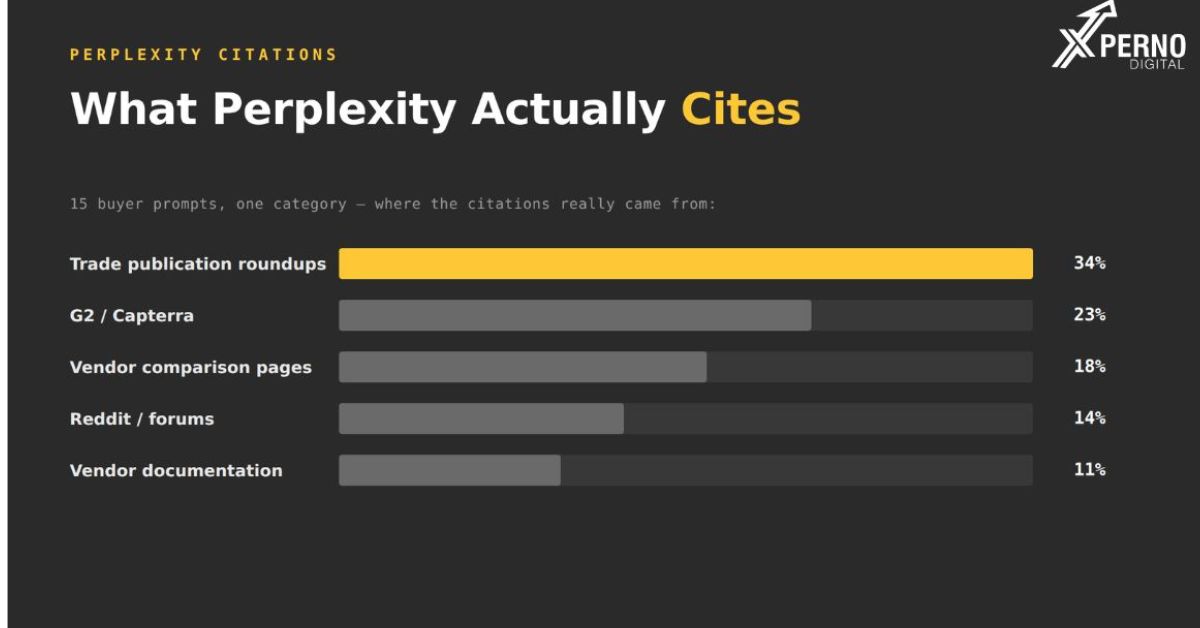
Run fifteen prompts, record every cited URL, and count which source types dominate.
This takes about an hour and produces the single most actionable dataset available in this discipline.
The output you want:
- Source type Citations % of total
- Trade publication roundups 22 34%
- G2 / Capterra 15 / 23%
- Vendor comparison pages 12 / 18%
- Reddit / forums 9 / 14%
- Vendor documentation 7 / 11%
Now you know where your effort belongs for your category, based on evidence, rather than on general advice.
Then check the specific URLs. If one roundup article accounts for eight citations, getting into that single article is worth more than a quarter of general content work. That is a targeted, achievable outreach task with a clear return.
Frequently Asked Questions:
Does Perplexity use Google’s index?
It uses multiple retrieval sources including its own crawler, PerplexityBot. It is not simply a wrapper over Google results, though there is overlap in what surfaces.
Should I allow PerplexityBot?
For B2B software, yes. Blocking it removes you from Perplexity citations entirely. Check your robots.txt and CDN settings.
Why does Perplexity cite my competitor and not me?
Usually one of three things: they have a page directly answering the question and you do not, they are present on a source Perplexity favours in your category, or your page lacks extractable claims.
How quickly does Perplexity reflect new content?
Faster than engines relying on trained knowledge typically weeks rather than months, since it retrieves live.
Is optimising for Perplexity different from optimising for ChatGPT?
The underlying characteristics are the same: extractable claims, comparative content, third-party corroboration. Perplexity weights recency and specificity more heavily.
Can I see which of my pages Perplexity has cited?
Not directly. You find out by running prompts and reading the citation list, which is why systematic monthly testing is worth the half hour.